This was a small code-golf experiment to see how much game logic I could compress without breaking it. The result fits the outcome logic on one line and the entire input loop on another. It is not the cleanest way to write a game, but finding the little Python tricks that made it possible was the whole point.
Play it here
Choose a move or press R, P, or S.
Result
Make a choice to start.
- Wins
- 0
- Ties
- 0
- Losses
- 0
The two lines
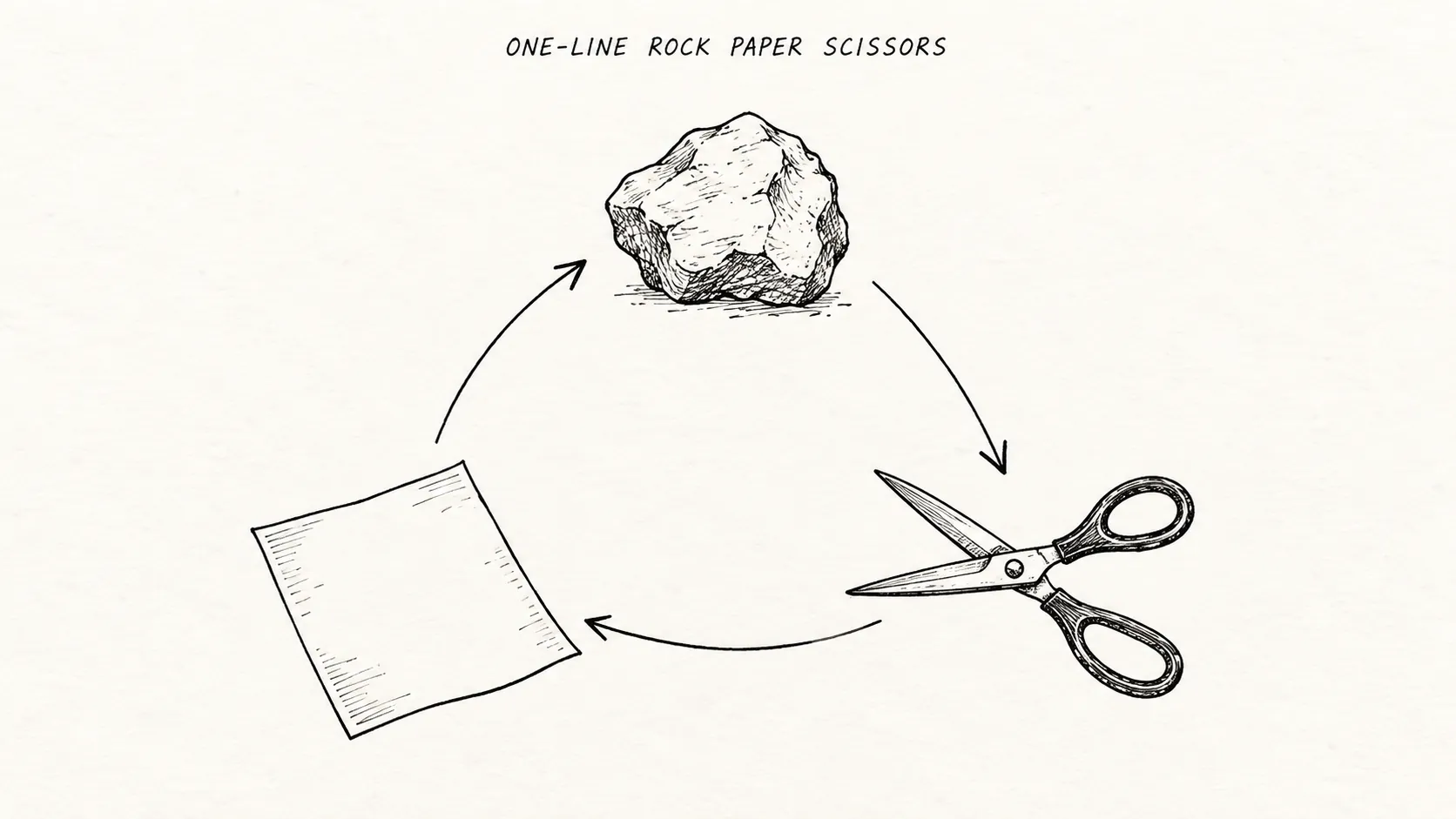
The game is a triangle rather than a straight ranking: rock beats scissors, scissors beats paper, and paper beats rock. The code turns that triangle into the numbered list [paper, rock, scissors], or [0, 1, 2]. Each choice beats the item one step ahead, with scissors wrapping from 2 back to paper at 0.
For paper and rock, adding one finds the choice they beat: 0 + 1 is rock, and 1 + 1 is scissors. Scissors is the wraparound case, so subtracting two turns its index 2 into paper's index 0. If neither test matches, equal indexes mean a tie and the remaining case is a loss.
Chained conditional expressions select the result text, while semicolons keep the input and output loop on one physical line. It is intentionally compressed code, but the triangle is the simple idea underneath it.
def get_res(str,c_num): return "You Win!!, I chose " + ["paper", "rock", "scissors"][c_num] if(["paper", "rock", "scissors"].index(str) - 2 == c_num or ["paper", "rock", "scissors"].index(str) + 1 == c_num) else "We Tied, I chose " + ["paper", "rock", "scissors"][c_num] if ["paper", "rock", "scissors"].index(str) == c_num else "You Lose, HaHa!, I chose " + ["paper", "rock", "scissors"][c_num]
choice = ""
while choice.lower() != 'q': choice = input("Rock Paper or Scissors (Q) - Quit: " ).lower(); print(get_res(choice, randint(0, 2)) if choice != 'q' else "Thanks for Playing!!")